Responsible
AI Practice
An annual service for nonprofits
navigating AI with intention.
Why the Practice Works
Most AI support for nonprofits starts with the technology. We start with leadership, because that's where the real work happens. How you protect trust, set boundaries, guide your team, and build governance that holds, that's what determines whether AI works for your organization or against it.
The Responsible AI Practice gives you an annual structure for doing that work, with a partner who understands the nonprofit context from the inside.
What we Hear
Nonprofit executives know AI holds real potential. They can see how it might advance their mission and give staff more time to focus on what matters most. But most don't have the time, capacity, or internal expertise to steward this moment well, let alone keep pace with a technology that keeps evolving.
They also know the risks are real. Donor data. Intellectual property. Equity. Bias. Staff burden. Reputational harm. The fear of falling behind or moving too fast without the right guardrails in place.
Our Approach
From Ghost Mode to Aligned Innovation
1
Proactive
Governance
Policy alignment, leadership clarity, governance structure.
2
Responsible
Use
Shared knowledge, foundational training, clear guidance.
3
Aligned Innovation
Ongoing learning, responsible adoption, mission alignment.
Practice Elements
Your staff is already using AI. This ensures they're using it well.
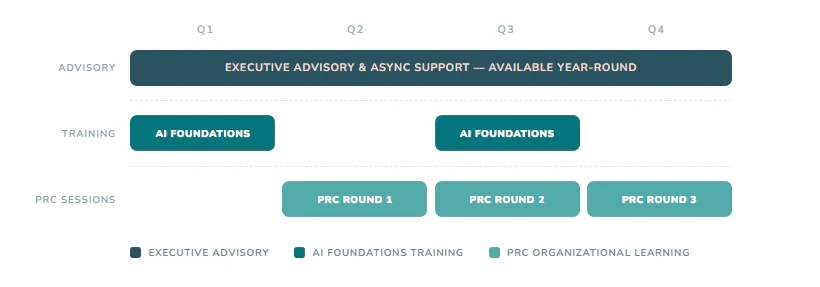
Two virtual training sessions per year, spaced roughly six months apart, grounded in your organization's values and governance. Not generic AI content. Sessions built for the nonprofit context, covering responsible use, emerging risks, and practical guidance your team can actually apply.
Serves as baseline orientation for new staff and optional refresher for existing staff as the landscape evolves.
Most leaders don't have full visibility into how AI is being used across their organization. These sessions change that.
Using TCC's Permission, Responsibility, and Co-Learning framework, we facilitate three structured team conversations annually. Each one surfaces real usage, clarifies boundaries, and identifies risks before they become problems. They also uncover where staff are already innovating, so those discoveries can be shared and scaled across the whole organization. For larger organizations, sessions are organized by department or team to keep conversations focused and every voice in the room.
Each round includes a written summary covering themes, risks, and recommended actions.
When a hard question lands on your desk, you shouldn't have to figure it out alone.
Up to four hours of direct advisory time with executive leadership annually, plus ongoing email and messaging access for questions on policy, tools, and emerging use cases. A knowledgeable partner available when it matters, not just at scheduled touchpoints.
Curious where your organization falls on the spectrum from Ghost Mode to Aligned Innovation? Complete the short assessment below.
"We didn't just stop feeling behind. We started building toward something."
— Executive Director, Youth-Serving Nonprofit
"They don't show up as consultants. They show up as leaders who've actually done this work and genuinely care."
— CEO, National Foundation
Ready to
Talk?
Most of our clients wish they'd started sooner. The good news is you're already asking the right questions.
The Collaborative Collective
We are a team of nonprofit executives and we exist for one reason: the future health and thriving of nonprofits and the people who lead them. AI is one part of that work. It happens to be one of the most consequential challenges nonprofit leaders are facing right now.
We are not technology consultants. We don't do beep boop. We approach innovation the same way we approach everything: through the lens of nonprofit leadership.
Our team has worked with more than 100 nonprofit boards. We understand how organizations actually function, where governance breaks down, and what responsible leadership through change looks like in practice.